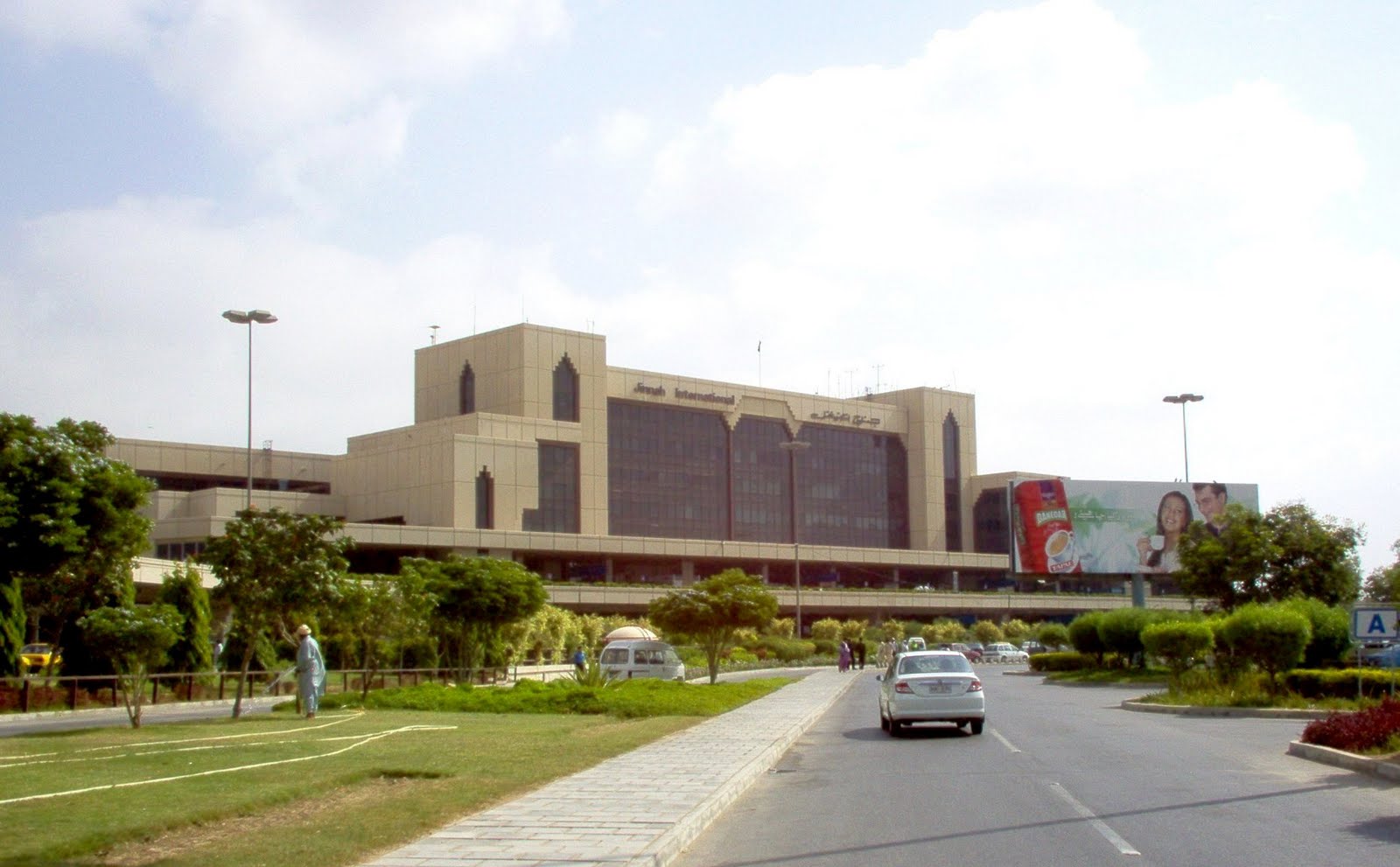
Jinnah International Airport
Jinnah International Airport previously Quaid-e-Azam International Airport (IATA: KHI, ICAO: OPKC) is Pakistan's largest international and domestic airport. It is located in Karachi, Sindh, and is also commonly known as the Jinnah Terminal. The airport is named after Muhammad Ali Jinnah, the founder of Pakistan, who was also known as Quaid-e-Azam ("Great Leader").
The airport provides primary hub for the flag carrier, Pakistan International Airlines (PIA), Shaheen Air International, and Airblue as well as many other private airlines. The airport is equipped with aircraft engineering and overhauling facilities including the Ispahani Hangar for wide-body aircraft.
History
During the 1940s there was a large black coloured hangar (also locally known as Kala Chapra) at the site of Karachi Airport, constructed for the British R101 Airship. Only three hangars were ever built in the world to dock and hangar the R101 airships. However, the R101 airship never arrived in Karachi (then part of the British Raj) as it crashed early in its journey in France. This hangar was so huge that aircraft often used it as a visual marker while attempting VFR landings at Karachi. Over the years, the hangar became known as the landmark of Karachi, until it was torn down by order of then-President Ayub Khan in the 1960s.
During World War II, Karachi Airport was a major transhipment base for United States Army Air Force units and equipment being used by Tenth Air Force in eastern India and Burma, as well as for Fourteenth Air Force in China. Several operational bomber and fighter units flew into Karachi for short organizational periods prior to their deployment. Air Technical Service Command had extensive facilities where aircraft were received, assembled and tested prior to being flown to their combat units at forward airfields. It also functioned as a major maintenance and supply depot for both air forces. In addition, Air Transport Command flew numerous cargo and passenger flights to the Middle East and to points within India and China.
The airport facilities were further expanded in the 1980s to Terminal 2 and Terminal 3 respectively. The present day infrastructure of Jinnah International Complex is a result of an expansion programme carried out in 1994. Today, the new Jinnah Terminal handles both domestic and international flights, whereas Terminal 2 is now dedicated to Hajj operations. Terminal 1 (which was actually the entirety of the airport in the British days) as well as Terminal 3 are now used for commercial offices, airline offices, and a string of bank counters and ATMs for public use.
Karachi was once a much busier airport. Between the 1960s and 1980s it was an online station of several major airlines of the world including British Airways, Interflug, TAROM, Alitalia, JAT Yugoslavia Airlines, Aeroflot, Philippine Airlines, Nigeria Airways, Ethiopian Airlines, EgyptAir, East African Airways, Kenya Airways, Air France, Qantas, Pan Am, Royal Jordanian, Libyan Arab Airlines, Japan Airlines, Syrian Arab Airlines, Middle East Airlines, Swissair, and SAS. However, due to the emergence of Dubai's airport on the world map, increased usage of longer haul aircraft, and the poor political climate of Karachi during the 1990s, several airlines discontinued their service to the airport.
In the past couple of years Karachi has seen a reversal in fortunes. The dwindling numbers of international airlines have stabilised and whilst there hasn't been a marked increase in the number of airlines flying in to Karachi, some have either increased the number of flights or resumed their old operations, either online or via codeshare service.
Economic factors may be partly responsible for the upswing in activity at the airport. As industrial growth in Karachi and the rest of Pakistan expands, some European and Asian carriers are mooting resumption of services to Jinnah International.
Structure
In fiscal year 2007-2008, over 26.6 million passengers used Jinnah International Airport. 249,283 aircraft movements were registered Jinnah International Airport in Karachi has always been the largest aviation facility in Pakistan. It is the primary hub of Pakistan International Airlines (PIA). All other Pakistani airlines also use Jinnah International Airport as their main hub. These include airblue and Shaheen Air International, as well as several charter carriers.
The building is linked via connecting corridors to two satellites, each having a provision of eight passenger-loading bridges. The eastern satellite is devoted exclusively to handling international operations. The western satellite is used for domestic operations, as well as some international operations. This is achieved through a flexible arrangement of gates. The two satellites supplement the departure lounges of the terminal building and also provide shopping facilities and snack counters.
The Jinnah Terminal was completed in 1992 at a cost of US $100 million - at the time the most expensive civil construction project in Pakistan[citation needed]. NESPAK (National Engineering Services Pakistan) and Airconsult (Frankfurt, Germany) were responsible for the architecture and planning of the terminal. Sogea Construction, a French company, was the contractor. Mukhtar Husain (NESPAK) was the Chief Architect for the new terminal.
In Karachi, the CIP Lounge can be used by all first and business class passengers on all outbound flights. Private banking clients of MCB Bank Ltd can also use the lounge on complimentary basis under contract to CAA as part of their benefits package. Only passengers who have been pre-issued an airline card from the check-in desk can enter the lounge. Other passengers who wish to use the lounge may do so upon payment of charges of USD 6.00 (international) or PKR 100/- (domestic). The lounge features light savoury snacks and non-alcoholic beverages, satellite TV, audio entertainment, newspapers, magazines, telephones, fax facilities, wireless Internet, and mobile charging points. There are also two McDonald's kiosks located on-site at the airport. airblue has also introduced their own lounge in the international terminal of the airport.
There are a number of banks that passengers can use at the airport including Askari Bank, Barclays, Citibank, Habib Bank, National Bank of Pakistan, MCB Bank, Royal Bank of Scotland, Standard Chartered Bank, and United Bank; which offer ATMs, foreign exchange facilities, traveler's cheque encashment, and personal banking. Private banking clients of Barclays worldwide (high net-worth individuals) now have their dedicated lounge as well. It features a hot buffet, speciality coffees, multimedia entertainment, shower and spa facility, and concierge service.
The airport is also where the majority of PIA's maintenance network is located, although some of its maintenance work also takes place at Benazir Bhutto International Airport, Rawalpindi. There are several hangars at the airport; the largest being the Ispahani Hangar (named after Mirza Ahmad Ispahani, the first chairman of PIA) that can accommodate two Boeing 747s and one narrow body airliner (e.g. Boeing 737) at one time. On 15 February 2006, the first major overhaul of a Boeing 777-200ER aircraft (known as "C" check) was done at Ispahani Hangar. Most of the PIA aircraft are checked and regulated at the aircraft hangars in Karachi. The PIA maintenance also check other airline aircraft in Karachi such as Philippine Airlines, Turkish Airlines, and Air Universal.


